
Marriage Services with Foreign Nationals (WNA)
Izinmubarak.com Legal Licensing Solutions and Sworn Translators
Marriage Services with Foreign Nationals (WNA)
Marrying a foreign national (WNA) is not only about uniting two hearts, but also about harmonizing two different legal and administrative systems. Each country has unique marriage regulations, so it's crucial for couples to understand the applicable requirements, both in Indonesia and in the foreign partner's home country. Furthermore, differences in culture, language, and customs can also present challenges that require thorough communication and preparation.
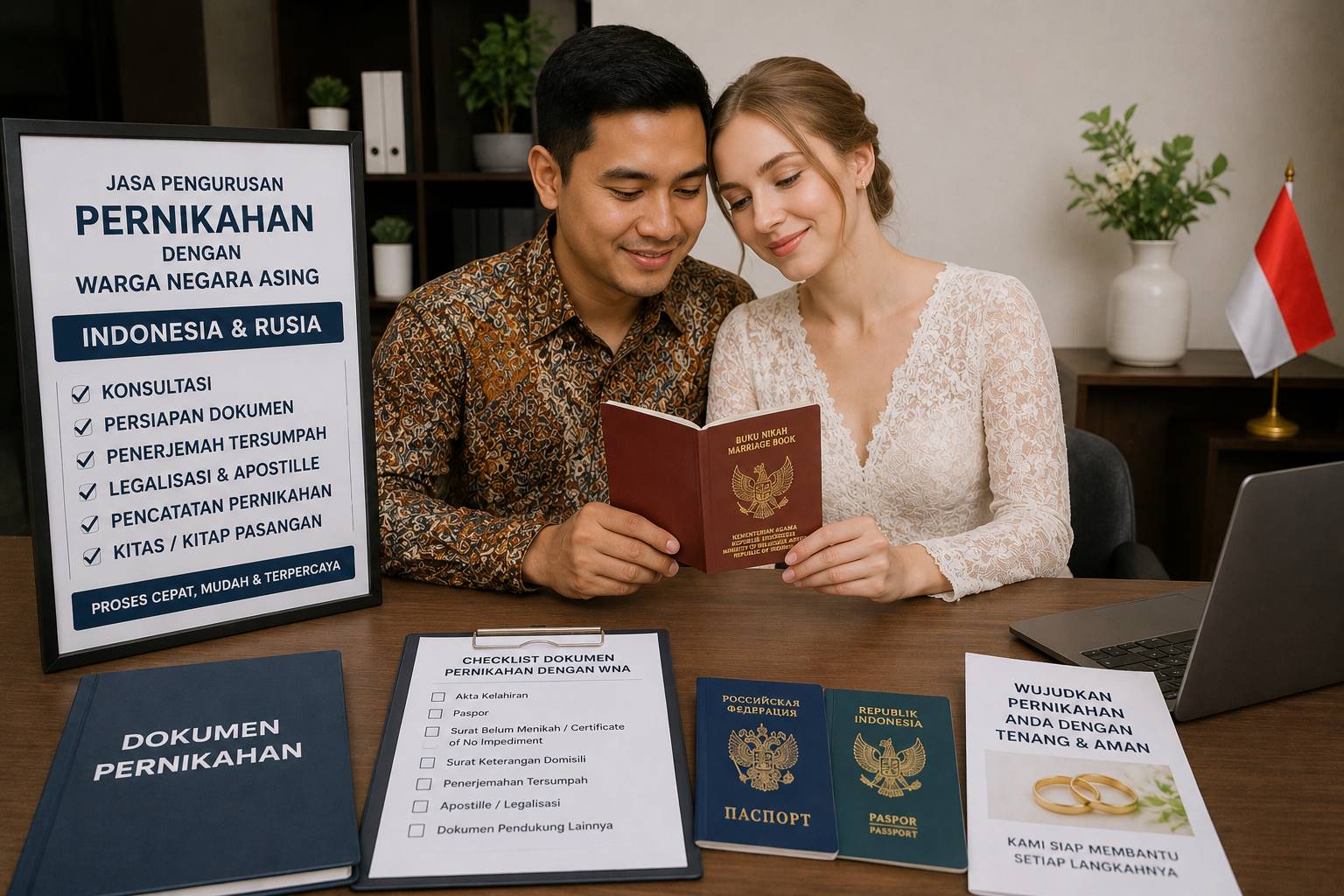
If you plan to marry a foreign national, there are various procedures and documents that must be prepared to ensure the marriage is legally valid in both countries. Documents such as a marriage license, birth certificate, and a certificate of unmarried status from the foreign partner's country of origin are often essential requirements. Furthermore, some documents must be translated into Indonesian or the language of the partner's country for official recognition. Translating foreign national marriage documents is not just a formality, but also a crucial step in ensuring the validity of the documents in further administrative processes, such as marriage registration, residence permit processing, or even future citizenship.
Requirements and Procedures for Marriage with a Foreign National in Indonesia
Marrying a foreign national (WNA) in Indonesia requires fulfilling several administrative and legal requirements set by the government. In addition to ensuring that the marriage is conducted in accordance with Indonesian law, couples must also consider the legal aspects applicable in the foreign national's country of origin. By fulfilling all established procedures, the marriage will be legally recognized in both Indonesia and the foreign partner's country. The following are the requirements and procedures to consider.
1. General Requirements for Marriage with a Foreign National
Marriage to a foreign national in Indonesia requires several basic requirements stipulated in Indonesian law. Some of the main requirements that both prospective bride and groom must meet include:
- Both prospective bride and groom must be at least 19 years old for the man and 16 years old for the woman, according to the Indonesian Marriage Law. If one of the prospective bride and groom is under this age, dispensation from the court is required.
- Marriages must be registered at the Religious Affairs Office (KUA) if the couple is Muslim or at the Civil Registry Office if the couple is of a non-Muslim faith. This registration is crucial for the marriage to have legal force.
- Marriage must be based on mutual consent without any element of coercion. If there is any indication that the marriage was conducted under duress or without the consent of either party, the marriage can be legally annulled.
- If one of the prospective bride and groom has been married before, then he or she must show official proof of divorce or death certificate of the previous partner if he or she is a widower or widow.
2. Required Documents for Marriage with a Foreign National
For a marriage to be valid, foreign nationals wishing to marry in Indonesia must prepare various required official documents. These documents serve to confirm the legal status of the foreign couple and fulfill administrative requirements in Indonesia. The following is a list of documents that prospective foreign brides and grooms must prepare:
- Original passport and copy as proof of identity and citizenship.
- A valid visa, whether it is a visitor visa, limited stay visa, or other visa that allows foreign nationals to be in Indonesia legally.
- A Certificate of Unmarried issued by the embassy or consulate of the country of origin of the prospective foreign bride and groom, which proves that they are not bound by marriage in their country of origin.
- Birth certificate that has been translated into Indonesian by a sworn translator and legalized by the competent authority.
- Marriage license from the authorities in the country of origin, which in some cases requires legalization or an apostille to be officially recognized in Indonesia.
- A statement of embracing Islam, if a Muslim bride and groom are marrying a non-Muslim partner who is willing to convert.
- Proof of temporary domicile in Indonesia, such as a residence certificate from the hotel, apartment, or house occupied while in Indonesia.
These documents are crucial to avoid future legal issues, particularly regarding marriage registration and legality in the foreign spouse's country. In some cases, additional documents may be required depending on the policies of the foreign spouse's country of origin.
3. Marriage Registration Process with Foreign Nationals
Once all the required documents are complete, the couple must register their marriage in accordance with Indonesian legal procedures. This registration ensures that the marriage is legally recognized and legally binding. The following steps must be taken:
- Submit a marriage registration application to the Religious Affairs Office (KUA) for Muslim couples or to the Civil Registry Office for non-Muslim couples. This application must be submitted along with all prepared documents.
- Undergo a document verification process, where authorities will check the validity and completeness of submitted documents. If there are any deficiencies or inconsistencies, the couple may be asked to complete them first.
- Attending the registration session or marriage ceremony, where the marriage will be carried out legally in accordance with applicable laws and religions.
- Obtaining a marriage certificate (for Muslim couples) or a marriage license (for non-Muslim couples) serves as legal proof that the marriage has been recognized by the state. This document is crucial for various future administrative purposes, such as obtaining a spouse's visa, transferring citizenship, or filing for inheritance rights.
- Legalization of the marriage certificate, if the couple plans to use their marriage document abroad. This legalization process can be done at the Ministry of Law and Human Rights, the Ministry of Foreign Affairs, or the embassy of the foreign couple's home country.
Translating Marriage Documents with Foreign Nationals: Why Is It Important?
When arranging a marriage with a foreign national (WNA), various documents must be translated into Indonesian or the language of the couple's home country, depending on legal and administrative requirements. This translation process is crucial to ensure that the documents are officially accepted and recognized by authorized government agencies, both in Indonesia and the couple's home country. If the translation is not done correctly or by a legally recognized translator, there is a risk that the documents will be deemed invalid, which could hinder the marriage registration process or other administrative matters.
In some cases, official institutions such as the Office of Religious Affairs (KUA), the Population and Civil Registration Service (Disdukcapil), the Ministry of Foreign Affairs, and the embassies of the couple's countries may request translated documents for legalization or an apostille. Therefore, it is important for couples to ensure that all necessary documents have been translated correctly and comply with applicable legal standards.
1. Marriage Documents with Foreign Nationals that Must Be Translated
Some documents that generally need to be translated in the marriage process with foreign nationals include:
- Birth certificate – Used to prove the identity and age of prospective foreign brides and grooms.
- Certificate of No Impediment to Marriage – This document is required to ensure that the prospective bride and groom are not bound by a previous marriage in their home country.
- Marriage permit from the country of origin – Some countries require their citizens to obtain official permission from local authorities before marrying abroad.
- Identity documents (if required) – Such as passport, national identity card (National ID), or other supporting documents that may be required in the administrative process.
- These documents must be translated accurately and in accordance with the official format recognized by the relevant government agency.
2. The Importance of a Sworn Translator for Marriage Documents with Foreign Nationals
Translating foreign national marriage documents cannot be done haphazardly. Documents must be translated by a sworn translator with official government authorization. A sworn translator is an individual certified and appointed by the Ministry of Law and Human Rights (Kemenkumham) or another official institution, ensuring that their translations are recognized by legal and government agencies.
By using the services of a sworn translator, couples need not worry about the validity of their documents. A sworn translator will ensure that the translation is accurate, complies with applicable legal terms, and meets the administrative requirements of the relevant agencies. Furthermore, documents translated by a sworn translator typically bear the translator's official stamp and signature as proof of their legality.
3. The Process of Translating and Legalizing Marriage Documents with Foreign Nationals
After the documents have been translated by a sworn translator, the couple may also need to have them legalized or apostilled, especially if they are needed for administrative purposes abroad. This legalization process usually involves several steps, such as:
- Legalization at the Ministry of Law and Human Rights (Kemenkumham) – To ensure that the translated documents comply with legal provisions.
- Legalization at the Ministry of Foreign Affairs (Kemenlu) – If the document will be used abroad, this ministry will certify the translated document.
- Legalization at the Embassy of the partner's country – If the foreign partner's country of origin has additional provisions, documents may need to be legalized at the Embassy or Consulate of that country in Indonesia.
Need Wedding Services with WNA (Foreign Citizens) Contact izinmubarak.com now.
Our Commitment
"We are committed to providing fast, accurate, and reliable legal licensing and sworn translation services, prioritizing client satisfaction and convenience at every stage of the process."





What Consumers Say
“Their Trust is a Testimony to the Quality of Our Services.”
“From Their Experience, You Can Trust.”

"The service was very fast and professional. My apostille process was completed without any issues. Highly recommended!"
Mr Q
"Thank you, IzinMubarak, for your sworn translation, which is neat and official. It's very helpful for my document requirements for traveling abroad."
Jessica
"Initially, I was confused about how to apply for a KITAS, but everything has become easy here. The team is responsive and informative."